
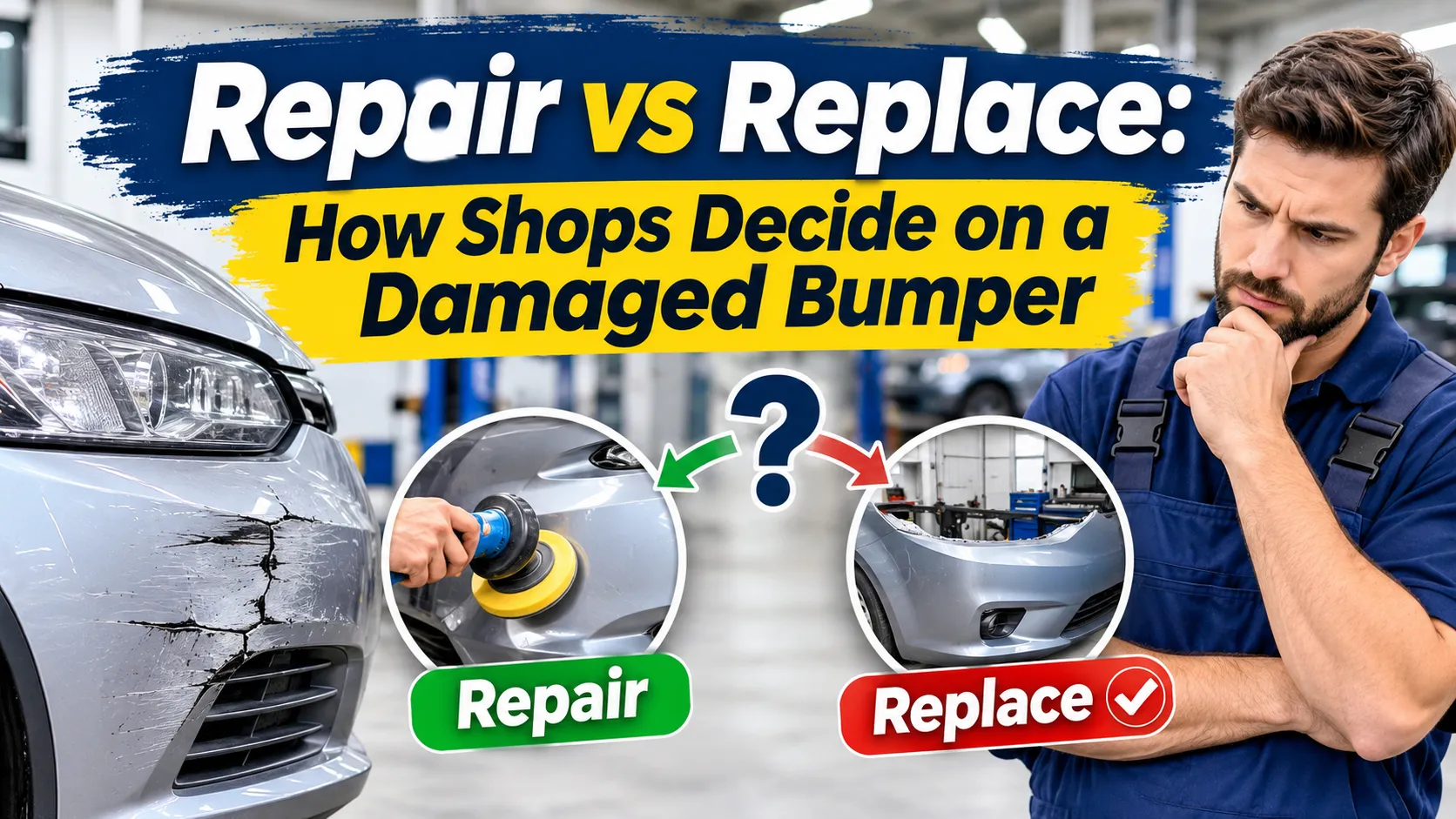
A cracked bumper doesn’t come with a price tag printed on it. Two cars can roll in with damage that looks almost the same and walk out with totally different invoices — one repaired, one swapped entirely. There’s no guesswork in that call. It follows a sequence of physical checks, material behavior, and cost logic most drivers never get to see. Repair vs replace damaged bumper decisions come down to what’s underneath the plastic, not what’s visible from the parking lot. Anyone researching dent repair in Rockland County runs into this exact fork fast: why do two similar-looking dents end up on completely different repair paths?
The First Five Minutes: What a Technician Actually Checks
2021 Honda CR-V comes in after a parking lot tap. Rear bumper cover’s pushed inward, nearly touching the quarter panel. Looks like a scratch-and-dent job from where you’re standing. The tech doesn’t start there. They pull the whole cover off first.
Underneath is the energy absorber — foam built to crush on impact. Behind that there’s a reinforcement bar made of steel or aluminum bolted directly to the frame rails. If that bar bends just a few millimeters everything changes quickly. A bent bar means the crash performance is no longer reliable even if the repair looks perfect, from the outside.
Clips matter too. Most bumper covers rely on eight to fourteen plastic clips and tabs to stay seated correctly. A hard hit snaps these in clusters, not one at a time. Three broken clips, maybe a bracket kit fixes it. Six or more near the headlight points, and the cover’s done holding shape on its own. This teardown is really what separates an honest dent repair in Rockland County estimate from a number scribbled in a parking lot.
Sensor brackets get checked last. Newer cars, 2018 and newer mostly have parking sensors or washer nozzles built into the bumper cover. Cracks, near those areas usually don’t stay a small problem. After a thousand miles of driving and shaking around the cracks get worse.
Five minutes, maybe less. But everything downstream — repair or replace, the cost, the timeline — traces back to this one teardown.
Repair vs Replace: The Line Shops Actually Draw
Two Toyota Camrys show up the same week, front bumper damage, both with a diagonal crack off the headlight corner. From three feet away they’re nearly identical. Up close, not even close.
Camry one: crack’s under four inches, sitting on a flat section away from any mounting tab. Substrate’s TPO — flexible, weldable, can take structural adhesive on the backside. That one gets repaired.
Camry two tells a different story. The crack runs straight through a mounting tab into a ribbed support section molded for strength. Once that rib cracks, it doesn’t flex back to spec, weld or no weld. Not an aesthetic call. Structural, plain and simple.
Three things tend to drive the bumper repair or replace decision on jobs like these:
-
Where exactly the crack sits relative to mounting points
-
Whether the backing material is flexible TPO or a reinforced composite
-
Whether the energy absorber or reinforcement bar shows any deformation
Two out of three pointing toward structural compromise, and bumper replacement stops being an upsell. It becomes the only honest recommendation. Patch a cracked mounting tab to save someone forty bucks, and you’re setting up a comeback — usually within a season, once road vibration finishes what the collision started.
Where Sensors and ADAS Change the Math
Jeep Grand Cherokee rolls in, minor front-end damage. Cosmetically it’s nothing — a fine crack, maybe two inches, right in the range that would normally get repaired without much thought. But this bumper’s packed with two parking sensors and a radar bracket feeding the adaptive cruise system.
Pull the cover and there’s a hairline fracture running straight through one sensor housing. Sensor tests fine on the bench, that’s not the problem. The housing no longer holds it at the calibrated angle. Off by a fraction of a degree, and the system throws false alerts, or worse, misses something it shouldn’t.
That’s the split between cosmetic repairability and functional repairability. Skin could be patched easy. Sensor geometry can’t. Replacement isn’t about crack severity here — it’s about precision failing at a point where precision is the whole job.
Shops handling auto body Rockland County work lean on OEM target boards or dynamic road calibration after a job like this, depending on the manufacturer’s spec. Skip that step after a bumper replacement, and you’re not saving time. You’re sending someone out with an uncalibrated safety system, and most techs won’t sign off on that regardless of what the estimate sheet says.
More cameras, more sensors packed into bumpers every model year. That’s pushing more borderline cases toward replacement, even when the plastic itself could’ve been saved.
Insurance, Paint Codes, and the Hidden Cost Variables
Insurer’s direct repair program approves a bumper repair on a mid-size sedan based on photos submitted through the claims app. Dent, short crack. Looks reasonable on paper.
Then the shop pulls the bumper and finds the reinforcement bar bowed near the driver’s side bracket. That never shows up in a photo taken from four feet away. So a supplement request goes in — a revised estimate after physical teardown. Standard practice, but it catches a lot of owners off guard who expected one flat number from the start.
Paint complicates things further. Three-stage finishes and pearl finishes require tinting and blending across the panels that’re next to each other not just the new bumper skin. Ask dent repair in Rockland County, about a single-stage color job compared to a three-stage pearl job and the labor hours are very different even when the damage is similar.
A few things that routinely move the final number:
-
OEM bumper skins fit differently than aftermarket ones, and paint adhesion varies too
-
Blend panels needed to match color across body lines
-
Labor hour disagreements between shop estimates and insurer software baselines
That’s the real reason the bumper repair or replace conversation often keeps going after the first estimate lands. Teardown tells you things photos simply can’t.
How Local Shops Like Spectrum Auto Approach These Calls
Shops doing auto body Rockland County work and covering the rest of Rockland County see this pattern constantly — damage that photographs as minor, then turns into a full replacement once the bumper actually comes off. Spectrum Auto Inc. is one regional example of a shop built around that teardown-first approach, checking structural and sensor components before locking in a final repair path.
Doesn’t matter which shop does the work, the lesson holds. A fair dent repair in Rockland County estimate depends on someone actually pulling the part apart, not glancing through a windshield or scrolling through uploaded photos. Ask to see what the teardown found, not just the bottom-line number. You’ll generally get a more accurate, more defensible estimate because of it.
Frequently Asked Questions
-
Can a cracked bumper always be repaired instead of replaced?
No. The outcome depends on where the crack’s located, what the substrate is made of and whether structural parts behind the skin—such, as the reinforcement bar—show any deformation.
-
Why did my estimate change after the shop took the bumper off?
Photos only capture surface damage. Teardown often turns up bent reinforcement bars or cracked mounting tabs that weren’t visible before, and that changes the recommended path.
-
Does a small crack near a sensor still mean full bumper replacement?
Usually yes. Sensor housings need geometry to work right. Even a small fracture, near the mount can throw off calibration.
-
Will insurance cover a bumper replacement if the first estimate said repair?
Often yes. Supplements are common. If a teardown reveals structural damage that the original photos didn’t show most insurers will look over the updated estimate. Approve it.