
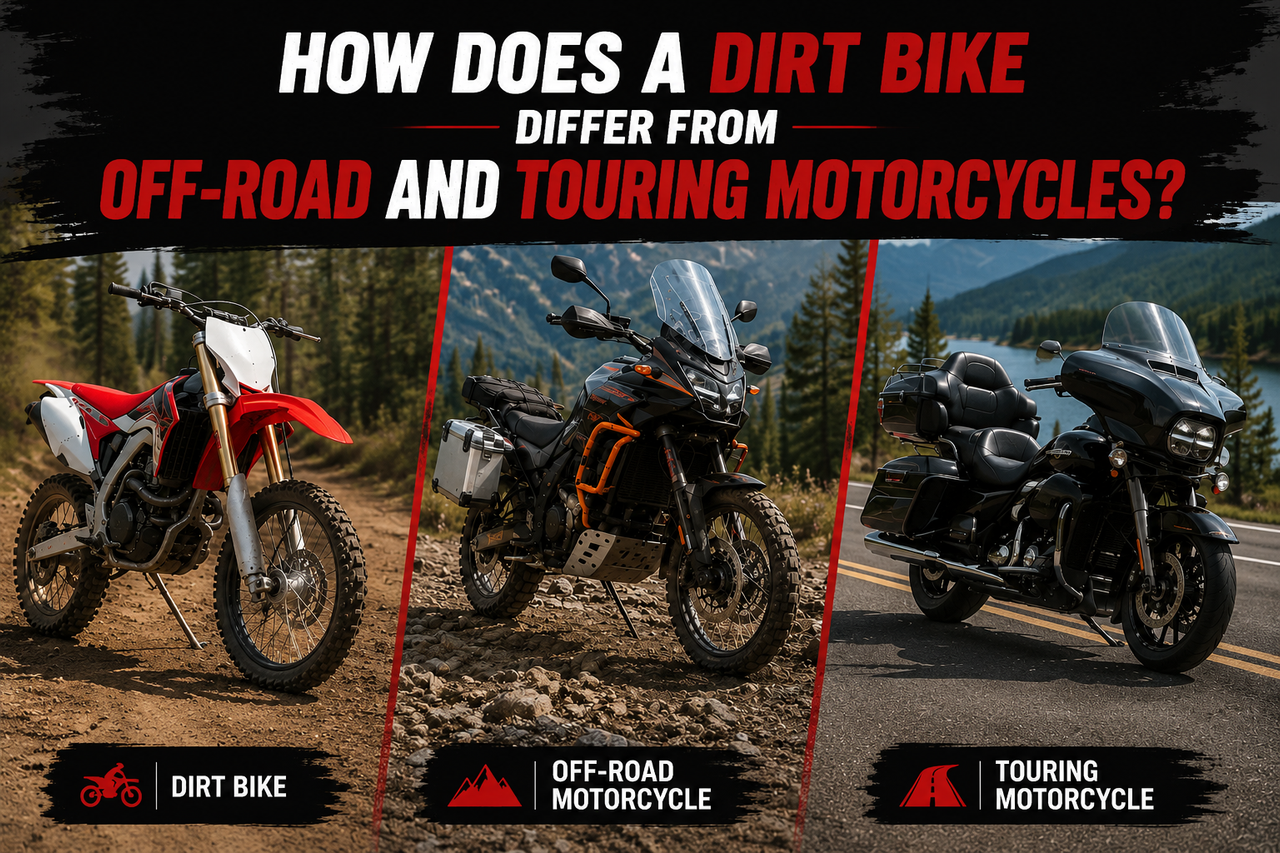
Dirt bikes, off-road motorcycles and touring motorcycles all have two wheels and an engine. That is roughly where the similarity ends.
Ride the wrong one for your terrain and you know immediately. This guide breaks down what separates them and helps you figure out which one actually fits how you ride.
What Is a Dirt Bike?
A dirt bike is a lightweight motorcycle built for off-road riding. Everything about it points in that direction.
The suspension travel is long. Often 10 to 12 inches front and rear. That is what absorbs rocks, roots and drops without the bike bottoming out. The tires are knobby and aggressive. They grip dirt and mud rather than asphalt. Ground clearance sits high enough to clear obstacles that would stop a street bike dead.
The seat is narrow and firm. The riding position is upright and active. You stand on the pegs through rough sections. There is no windscreen. No storage. No passenger seat. Just what the machine needs to go off-road and nothing it does not.
CTA: [Browse Dirt Bikes at Texas Motor Sports]
Types of Dirt Bikes
Not all dirt bikes do the same thing. Each type is designed for a different riding style, terrain, and experience level.
Trail Bikes
Trail bikes are the most common starting point. Built for recreational riding on forest tracks and mixed terrain. Manageable power. Accessible for most experience levels.
Motocross Bikes
Motocross bikes are track machines. Purpose-built for groomed circuits with jumps and berms. They perform badly on natural terrain and have no place on a road.
Enduro Bikes
Enduro bikes sit between those two. Long-distance off-road competition across real terrain. Many are street legal in some markets and carry basic lighting.
Dual-Sport Motorcycles
Dual-sport machines handle both pavement and dirt. They compromise in both directions but open up routes that pure dirt bikes and pure road bikes cannot cover.
Dirt Bikes and Off-Road Motorcycles
Every dirt bike is an off-road motorcycle. Not every off road motorcycle is a dirt bike.
The broader off-road category includes adventure bikes and dual-sport machines that make room for road riding and longer distances. A dedicated dirt bike like a motocross machine makes no such concession. It is optimised for one environment and performs poorly outside it.
For riders spending most of their time on trails and unpaved terrain, a proper dirt bike or purpose-built off road motorcycle is the right starting point. Whether the riding involves any road sections at all is the question that splits the two.
Dirt Bike vs Touring Motorcycle
These two are built for completely opposite purposes.
| Feature | Dirt Bike | Touring Motorcycle |
| Riding Purpose | Off-road trails and rough terrain | Long-distance road travel |
| Terrain | Dirt, mud, rocks, rough tracks | Paved highways |
| Comfort | Minimal, active riding position | High, built for hours of riding |
| Design | Light, minimal, high clearance | Heavy, full-featured, low clearance |
| Fuel Range | Short, small tank | Long, large tank |
| Luggage | None | Integrated storage standard |
A touring motorcycle is heavy by design. Windscreen, heated grips, large fuel tank, integrated panniers and a seat built for a full day of riding. All of that adds weight because long roads require it.
None of those features appear on a dirt bike. They would get in the way.
Can a Dirt Bike Be Used for Touring?
You can. It is genuinely uncomfortable though.
Small fuel tanks mean frequent stops. The suspension is tuned for rough ground and transmits road buzz on smooth pavement. The seat becomes painful well before a full day of highway riding. There is nowhere to put gear.
Some riders do use enduro and dual-sport machines for extended trips across mixed terrain. Those are not pure dirt bikes but they share the DNA. For actual highway touring a touring motorcycle is the right tool. Trying to make a dirt bike do that job is a choice you notice in your back by midday.
Dirt Bike Brands
Brand loyalty matters less than matching the specific model to what you plan to do.
Major dirt bike brands all produce trail, enduro and motocross lines. A competition motocross machine from a well-known brand is still the wrong choice for a beginner on trails. A mild trail bike is still wrong for someone racing at club level.
Engine size, suspension setup, weight and power delivery vary significantly across models. Test riding and talking to people who ride the same terrain you plan to ride will tell you more than brand reputation alone.
CTA: [Explore Motorcycle Inventory at Texas Motor Sports]
Beginner Dirt Bike
The right beginner dirt bike makes learning feel manageable. The wrong one makes everything harder than it needs to be.
Smaller engines in the 125cc to 250cc four-stroke range give new riders enough power without the aggressive delivery that competition machines have. The bike should allow at least one foot to touch the ground from the seated position. A seat height that forces the rider onto their toes before they have built confidence is a problem that shows up fast.
Weight matters too. A lighter bike is easier to pick up after a fall. Falls happen when you are learning. That is not a criticism. It is just how off-road riding works at the start.
Adult Starter Dirt Bike
Adults starting out face slightly different considerations than younger riders.
A 250cc four-stroke trail bike is where most adult beginners land. Taller or larger adults sometimes need to look at a 450cc machine purely for physical fit even if the power delivery requires careful management early on.
Terrain is a bigger factor than most people give it credit for. Learning on open flat trails is different from learning on tight technical singletrack. The second requires precise low-speed control more than horsepower. Match the bike to the actual terrain rather than buying for the terrain you eventually want to ride.
Choosing the Right Dirt Bike
- Start with where you are riding. Trail bikes, motocross bikes and enduro bikes all exist because the terrain demands are different. Buying the wrong type for your terrain is the most common mistake and it does not get fixed by riding style or experience.
- Experience level comes next. An honest read of where you are as a rider matters more than where you plan to be in a year.
- Physical fit affects both safety and enjoyment. A bike that does not fit the body correctly is harder to control in every situation.
- The budget should cover the bike and protective gear. Saving money on the bike by skipping proper gear is not a reasonable trade.
CTA: [Talk to Our Team About Finding the Right Dirt Bike]
FAQs
Is a dirt bike basically a motorcycle?
Yes. A dirt bike is a motorcycle built specifically for off-road use. Same fundamental mechanics as a street bike but the suspension, tires, frame and riding position are all set up for rough terrain rather than paved roads.
Can a dirt bike go 100 mph?
Some high-performance dirt bikes can hit or exceed 100 mph depending on engine size and gearing. Most trail and beginner bikes are not built for those speeds and would be hard to control at them. On actual off-road terrain the ground limits practical speed well below that anyway.
What are the three types of dirt bike?
The three main categories are motocross bikes for closed-circuit racing, trail bikes for recreational off-road riding and enduro bikes for long-distance off-road competition across natural terrain. Dual-sport machines bridge off-road and road use and are sometimes counted as a fourth type.
What size dirt bike should an adult start on?
A 250cc four-stroke trail bike covers most adult beginners of average height and build. Taller or larger adults may need a 450cc for physical fit even while managing the power carefully in the early stages.
Is 250cc enough for 2 people in the US?
Dirt bikes are single-rider machines regardless of engine size. Carrying a passenger on one is not safe. For two-up riding a motorcycle with proper passenger seating is the right choice.