
Fleet downtime is expensive. Not in a vague, “it adds up over time” way. In a very specific, $448-to-$760-per-vehicle-per-day way, depending on whose numbers you trust. And most of that cost comes from one thing: nobody knew the truck was about to break down until it did.
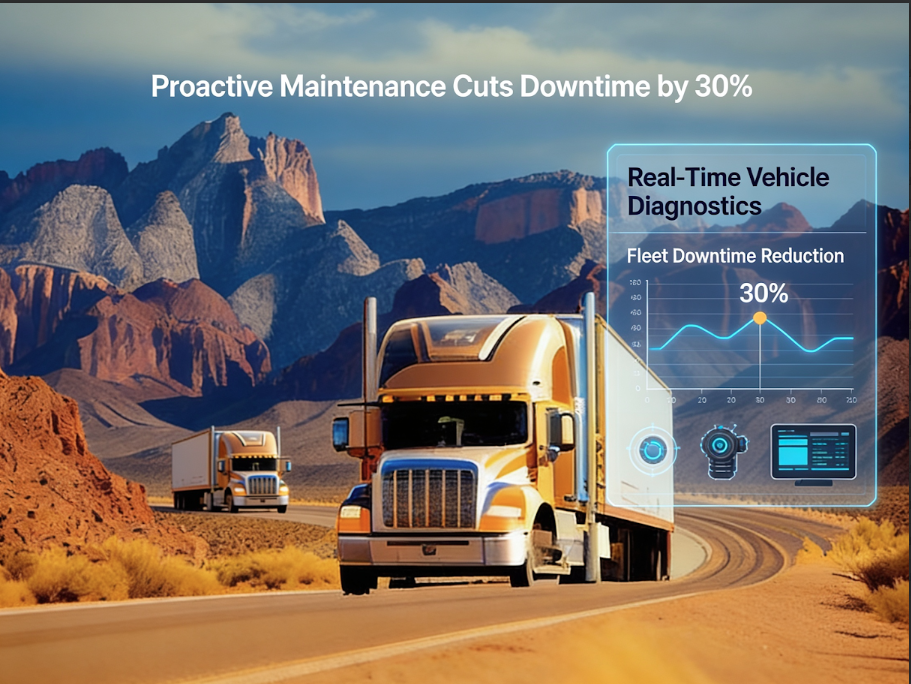
That’s changing now. Real-time vehicle diagnostics have moved from “nice to have” to “how did we run a fleet without this?” And the fleets using them are seeing downtime drop by roughly 30%, sometimes more.
Let me break down what’s going on.
The old way was basically guessing
For decades, fleet maintenance worked on schedules. Oil change every 10,000 miles. Brake inspection every 90 days. Engine check twice a year. The schedule didn’t care whether the vehicle needed maintenance or not. You did it anyway, or you waited until something failed on the highway.
Both approaches cost money. Over-maintenance wastes parts, labor hours, and takes trucks off the road that were running fine. Under-maintenance leads to breakdowns, tow bills, missed deliveries, and angry customers. Neither approach used actual data from the vehicle itself.
The problem was always information. Fleet managers were making decisions about thousands of moving parts with almost no real-time input on how those parts were actually performing.
What real-time diagnostics actually do
Real-time vehicle diagnostics pull live data from a vehicle’s onboard systems, engine control units, sensors, and communication modules. We’re talking engine temperature, oil pressure, battery voltage, transmission behavior, fuel injection patterns, exhaust readings, and dozens of other parameters.
The difference from older telematics is that this data isn’t just collected and stored for later review. It gets analyzed continuously. When a pattern looks off, say the coolant temperature is climbing slightly over a few days, the system flags it before the engine overheats on I-95.
Platforms like Intangles take this a step further. Instead of just reading fault codes after they trigger, their system uses AI to detect anomalies in vehicle behavior before a fault code even appears. That’s a meaningful difference. A fault code means something already went wrong. An anomaly detection means something is starting to go wrong, and you have time to fix it on your terms.
Where the 30% reduction actually comes from
The 30% number isn’t magic. It comes from three specific places:
Fewer surprise breakdowns. When you catch a failing alternator three days before it dies, you replace it during a scheduled stop instead of on the side of the road. The repair is the same. The cost and disruption are completely different. Roadside repairs typically cost 2x to 3x more than shop repairs, and that’s before you count the lost delivery revenue.
Smarter maintenance scheduling. Instead of changing oil at fixed intervals regardless of condition, real-time data tells you when the oil actually needs changing. Some vehicles run harder than others. A truck doing highway miles in mild weather doesn’t need service as often as one doing stop-and-go in Phoenix heat. Condition-based maintenance means fewer unnecessary shop visits and less time off the road.
Faster diagnosis when problems do happen. When a vehicle does come in for repair, the technician already has the diagnostic data. They don’t spend an hour figuring out what’s wrong. They spend that hour fixing it. Diagnosis time drops, repair time drops, and the vehicle goes back on the road faster.
Running the numbers on a mid-size fleet
Take a fleet of 200 delivery trucks. Without real-time diagnostics, maybe 8 to 12 vehicles are out of service on any given day due to unplanned repairs. That’s 4-6% of the fleet sitting idle, burning money.
With real-time diagnostics catching problems early, that number drops to 5 or 6 vehicles. The ones that are down are there for planned maintenance, not emergencies. The repair costs are lower because nothing escalated into a catastrophic failure. And the fleet manager actually slept through the night because their phone didn’t ring at 2 AM about a truck stranded in Nebraska.
The math works out to roughly a 30-40% reduction in unplanned downtime. For a 200-truck fleet, that can mean $300,000 to $500,000 saved per year in direct costs alone.
What to look for in a diagnostics platform
Not all telematics platforms offer the same depth of diagnostics. Some just give you GPS tracking and call it fleet management. If you’re evaluating options, here are the things that actually matter:
Does it go beyond fault codes? Any OBD reader can pull a check-engine light. You want a system that spots problems before the warning light comes on. AI-based anomaly detection, like what Intangles uses in their predictive maintenance system, catches degradation patterns that fixed-threshold alerts miss entirely.
Does it work without extra hardware bolted onto every truck? Some platforms require proprietary devices on every vehicle. That’s fine if you have 20 trucks, but it gets expensive and logistically painful at scale. Look for platforms that work with existing vehicle systems.
Can you act on the data, or just look at it? Dashboards are nice. Actionable alerts that tell a fleet manager “Vehicle #147 needs a belt replacement within the next 500 miles” are useful. There’s a big gap between the two.
Does it integrate with your maintenance workflow? The data needs to flow into your work order system or your maintenance team’s process. If the alert goes to a dashboard nobody checks, it’s worthless.
The fleet managers who are hesitant
Some fleet operators still resist the switch, and their reasons are usually practical, not philosophical. They worry about data overload, alert fatigue, integration headaches with legacy systems, or the upfront cost of implementation.
These are fair concerns. But here’s what I’ve noticed: the fleets that adopt real-time diagnostics and actually use the data almost never go back. The cost savings are too obvious. And the technology has matured enough that the integration pain is much lower than it was even three years ago.
The fleets that wait tend to wait until a particularly expensive breakdown forces the conversation. That’s a more expensive way to learn the same lesson.
So, is it worth it?
Real-time vehicle diagnostics aren’t futuristic technology anymore. They’re what separates fleets that plan from fleets that react. The 30% downtime reduction is a real, measurable outcome. It comes from catching problems earlier, maintaining vehicles based on actual condition, and getting repairs done faster.
If your fleet is still running on scheduled maintenance and hoping for the best, the gap between you and competitors who’ve already made the switch gets wider every month. And it won’t close on its own.